

The food we eat is making us sick. In the United States and around the world, diet has become the leading cause of illness and premature death, from obesity and diabetes to heart disease and other chronic ailments. Advocates of healthier diets pin the blame on overeating, but the bigger issue is what we undereat—the dearth of food that nourishes and heals.
Amazon page synopsis for Food is Medicine, by Dariush Mozaffarian, MD, DrPH
Defining a healthy diet would be so much easier if we could just leave meat, and maybe animal-sourced foods in general, out of it.
Then we might all agree that fruits (at least the lowish-sugar, highish-fiber kind), vegetables (at least the green, leafy ones), nuts and legumes are better than sugars and ultra-processed foods, however we define those. We could then focus our nutrition and public health initiatives either on getting rid of the foods that are making us sick, or on making sure everyone has ample access to the foods that nourish and heal.
That latter approach is now captured in the phrase Food is Medicine (FiM). It’s the title of a new book by Dariush Mozaffarian, whom Amazon describes as a “world-renowned expert in nutrition, medicine and public policy,” and I won’t quibble with that. It’s also the name of an institute Mozaffarian founded at Tufts, a national coalition of non-profit organizations, and the conference the coalition hosted in Washington this past June.
FiM is now one of two dominant, closely related themes in mainstream nutrition policy, along with the campaign against ultra-processed foods, which I’ve discussed (here and here). Both style themselves as revolutions, rejecting the 20th-century reductionist science of macronutrients — carbs, fats and proteins — for a more holistic approach that may or may not be compatible with functional science.
This post is about FiM, Mozaffarian’s thinking, and the problems that meat and, yes, once again, the ketogenic diet trials raise for both. Mozaffarian, like Andrew Huberman in my last post, writes around these issues. I’m going to point them out, because I don’t think science or public health benefits from avoiding them.
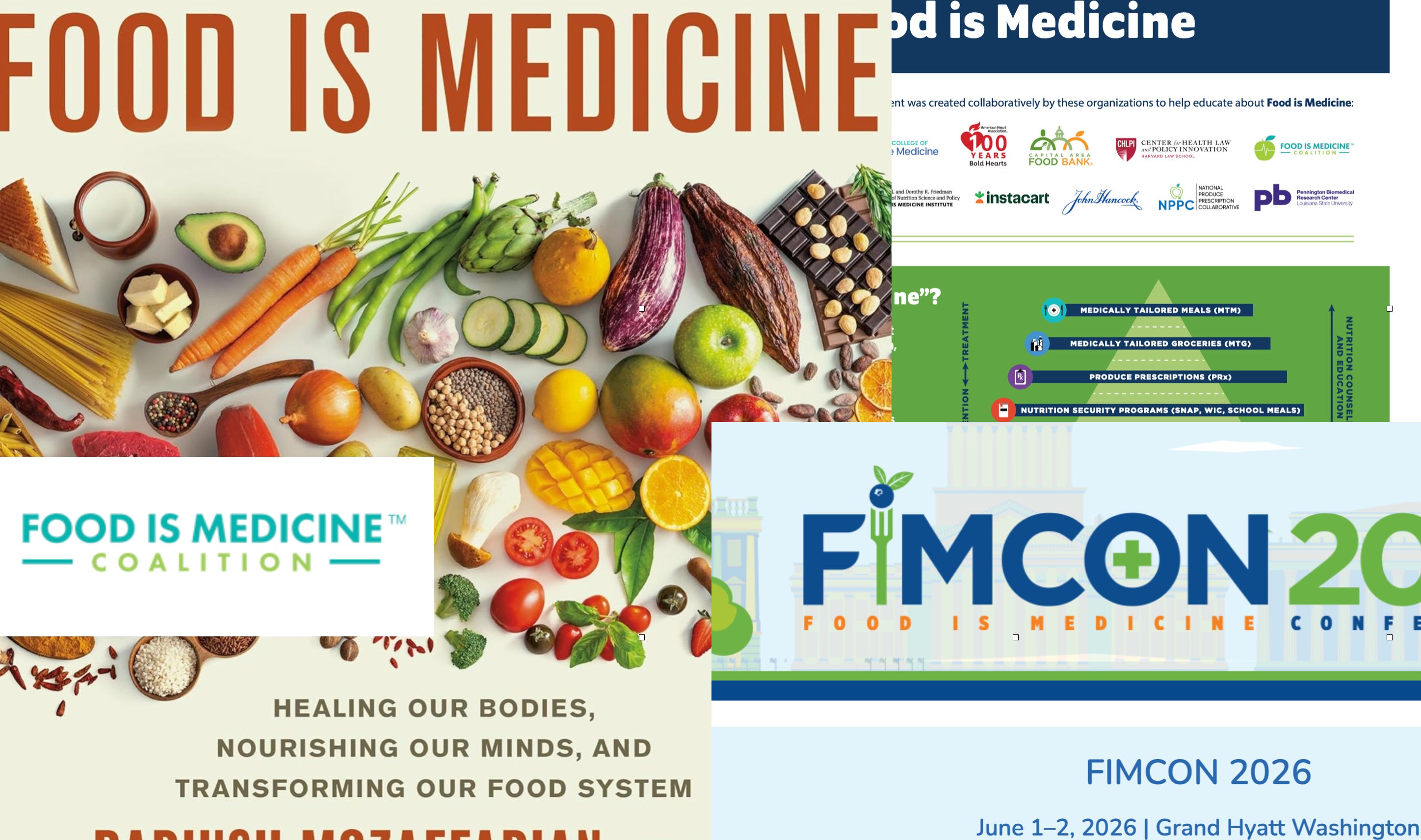
The (revolutionary) essence of Food is Medicine
Mozaffarian’s book never gives a concise definition of Food is Medicine, but he does offer a kind of writerly description. Several FiM principles, he says, “challenge long-held assumptions,” including these:
A central priority, for example, is not deprivation—avoiding what is bad—but celebration, embracing that which is good. Diet-related disease is commonly viewed as a problem of excess: too much fat, too much sugar. This outdated orthodoxy frames eating in terms of willpower, restriction, and punishment. The deeper failure is insufficiency: a dearth of nourishing food. Advancing the good, rather than merely avoiding the bad, is at the core of unleashing food as medicine. Food is medicine, after all, is not about medicalizing food; it’s about naturalizing the approach to well-being. Abundance and flavor are integral parts of a healthy diet.
The “outdated orthodoxy” framing is a bit beyond the pale, because we don’t actually know if it’s wrong. That’s what Mozaffarian calls the “multi-trillion dollar question.”
My research has suggested that if you add sugar and refined grains to any baseline, traditional human diet--from mostly animal, to mostly plant--you’ll generate epidemics of obesity, diabetes and their related chronic diseases. That implies the too-much framing is appropriate (if we ignore, as Mozaffarian does, that the too-much phrasing is invariably tautological).
And Mozaffarian certainly accepts that there are bad foods, the ones we eat too much of and that make us sick. His leading candidates are sugar and refined carbs, so we agree there. (He suspects that the “white rice and white bread” of his otherwise nourishing childhood diet might have contributed to the massive heart attack his physician father suffered at 47.) He also thinks saturated fat has been unfairly maligned and is benign. We’re aligned there, too.
But the bottom line of the FiM philosophy is that the chronic diseases most likely to kill us are caused less by the bad foods than by a dearth of “nourishing food.” They are, in effect, nourishing-food insufficiency disorders. Hence the way to make an unhealthy population healthy — “unleashing food as medicine” — is to make those nourishing foods available to the people who need them, whether hospital patients or underserved members of the community, and to communicate their medicinal virtues to the rest of us.
It sounds great, but… I’m skeptical. Because we don’t actually agree on the foods that make people healthy, and we don’t know which side of this debate is right.
The epidemiology problem
In an ideal world, randomized controlled trials would minimize these unknowns, but we all acknowledge they’re exceedingly challenging and exorbitantly expensive. In their absence, FiM nutrition science is based almost exclusively on nutritional epidemiology.
Mozaffarian is a cardiologist, but after he got interested in nutrition (in the 90s, as I did), he became a nutritional epidemiologist, learning his craft from the Harvard epidemiologists who are such regular subjects of discussion in this Substack. Beyond Mozaffarian’s interpretation of the history of the relevant nutrition science, the book's scientific substance is the epidemiology he and others have done to ground the FiM philosophy. Throughout, the assumption — as often explicit as implicit — is that the associations these surveys observe between diet and disease are causal. (This isn’t the place for yet another discussion of why evidence-based medicine rightly considers this evidence to be low- or very-low quality at best. For a refresher, read here, here, here and here.)
In the world of nutritional epidemiology, now the FiM world, the foods that nourish us are the foods healthy people tend to eat and unhealthy people don’t. Because the healthy people in these surveys tend to be health-conscious, these are also the foods nutritional authorities have been telling us to eat for decades. That may be a coincidence, a confirmation that the authorities were right all along, or a fundamental flaw in the science. Another multi-trillion-dollar question, although one that worries me more than Mozaffarian.
Those who don’t eat these foods either can’t afford to prioritize health over cost and convenience, or they don’t care or know enough to make the effort. The two groups differ in virtually every way: education and socio-economic status, the quality of their doctors and medical care, their leisure-time physical activity, their non-dietary lifestyle (even, I’d bet, the cars they drive). Mozaffarian acknowledges that “eating a healthy diet has become so challenging and rare, it suffers from a stigma of elitism.” I agree. But that makes the epidemiology impossible to interpret, and Mozaffarian and his colleagues skate past it.
Hence, to Mozaffarian, the foods that nourish and heal are the foods that the elite tend to prioritize and, well, the less-elite don’t: fruits, vegetables, nuts, legumes, whole grains, (non-toxic) plant oils, fish and fowl, and yogurt.
Medicinal, or merely benign (or not even that)?
Mozaffarian discusses these foods as though they do indeed have medicinal properties. Eat them — like Popeye and his spinach — and we will once again become healthy, or stay lean and healthy if we’re predisposed to become otherwise. “I’m confident that eating more broccoli, salmon, or almonds is, on average, a good thing,” he says. And he might be right.
He is also confident that eating these foods is better than eating, say, French fries, a Big Mac and a Snickers bar. There we certainly agree. But will we make Americans healthier by telling them that broccoli, salmon, and almonds are nourishing, or by telling them that French fries make them fat, as does the Snickers bar and maybe the bun on the Big Mac, but not the patty, tomato, lettuce, or onion? (I’m not speaking for the special sauce.) That’s the message those of us who pay attention to the ketogenic diet science might be tempted to send.
Mozaffarian does believe that ever-larger portion sizes are one reason Americans got fatter, but he thinks it depends on which foods: “If food manufacturers and restaurants had enlarged their offerings of minimally processed eggs, cheese, chicken, and beans,” he says, “waistlines might not have grown. And if they had amplified unprocessed fruits, vegetables, nuts, whole grains, yogurt, and seafood, the nation might even have lost weight.” Still, he adds, “it would be nice to be certain.” And, yes, it would.
I think of the FiM’s nourishing foods not as medicinal but as benign: harmless for the most part, but even that depends on the individual. The ketogenic diet science suggests that the more carb-rich foods on Mozaffarian’s list — whole grains, beans, some of the fruit — would be problematic for those of us who got fatter over the past half century, but perhaps not for him, assuming he’s always been as lean as he has for the decade or so I’ve known him.
That matters because, as Mozaffarian tells us, most of the population is now overweight or obese, half is prediabetic or diabetic, and some huge proportion has a chronic disease of some sort. What lean and healthy (and, in my view, health-conscious) people can tolerate may be problematic for the rest of us.
So to understand and assess the FiM health reform initiative, we have to keep our eyes on its essential proposition: that people are unhealthy because their diets lack FiM’s nourishing foods, and that getting them to eat those foods will make them healthier.
If so, these foods are, well, medicinal, and like any medicines, they have to be tested. If we give fruits, vegetables, whole grains, and legumes to a typical American with obesity or diabetes, will they get healthier? Will their disorders go into remission? If they’re predisposed to these disorders, will these foods prevent them? And if we’re going to treat food as medicine, the same principles should apply: it’s not sufficient, or perhaps even ethical, to prescribe one treatment when we know of another that’s safe and more effective.
