
Is There a Boring Truth About Obesity?
Why are Derek Thompson and Andrew Huberman certain the obesity epidemic is as simple as elementary physics?

You know, the more I report on science, the more I find that like the single most underrated question in science is how do we know that?
Derek Thompson, Plain English Podcast, “Why Are Americans So Unhealthy?”
Derek Thompson’s right about the importance of the question, although I’ll use the singular pronoun: How do I know that? That’s the essential question of any scientific endeavor, another way of asking “can I trust my judgement?” or, as Feynman might have said, “am I fooling myself?”
When science gets translated for public consumption, however, the question becomes how do they know that. Now we’re asking about sources of expertise.
Thompson, for instance, is a journalist. He’s a former staff writer for The Atlantic who now publishes his own Substack newsletter. He also hosts the Plain English podcast. With Ezra Klein of The New York Times, he’s a co-author the recent Times #1 best-seller Abundance. Amazon says its “a once-in-a-generation, paradigm-shifting call to renew a politics of plenty, face up to the failures of liberal governance, and abandon the chosen scarcities that have deformed American life.”
In short, Thompson’s influence seems well-earned. So when he recently wrote a Substack post, “The Boring Truth About Why Americans Got Fat,” and that boring truth, he said, was that we ate too much,1 I’d be tempted to accept his judgement. But how does he know that?
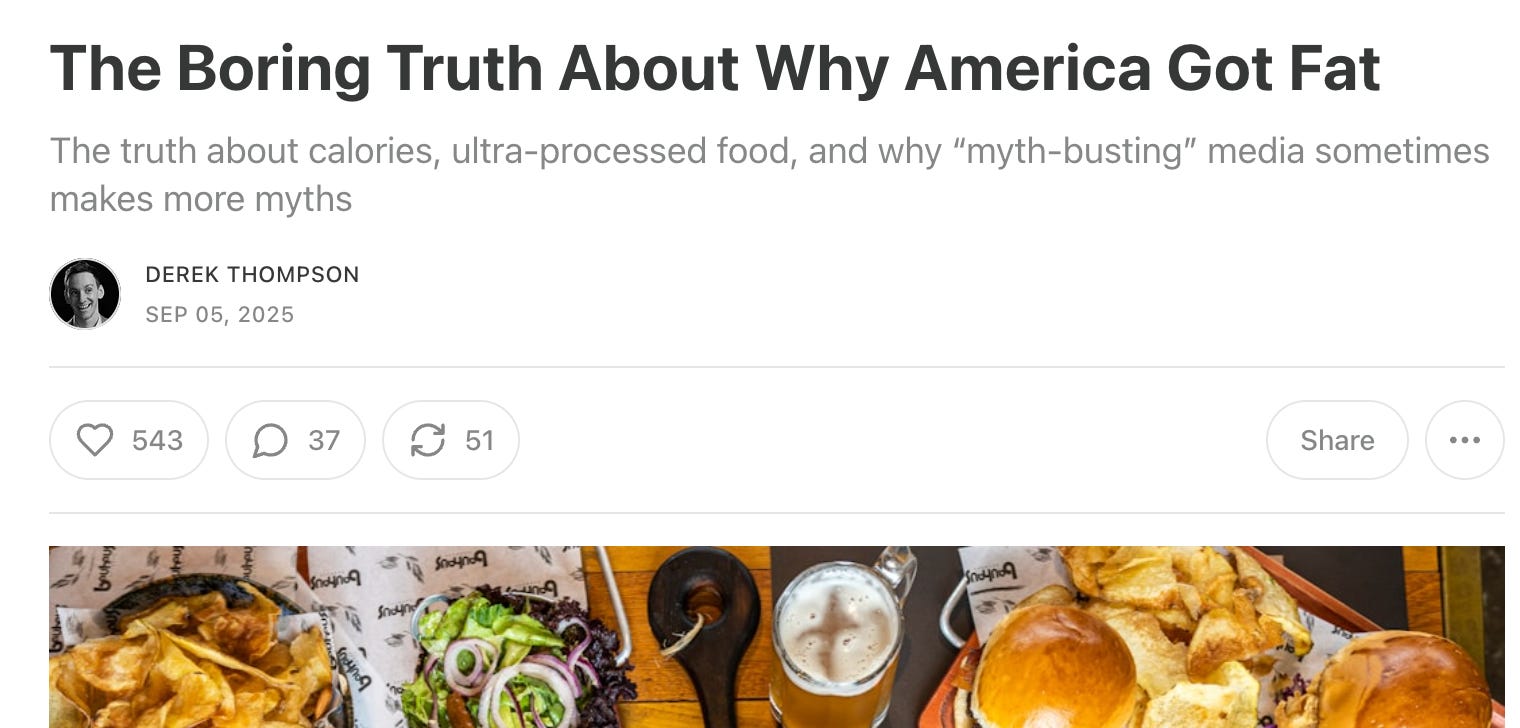
One of his readers, Julie King, responded to his post by asking, in effect, that question. “Respectfully,” King comments, “I don’t understand what gives you authority on this subject.”
Regrettably, Thompson did not respond. He could have used the opportunity to give us his thoughts on the nature of expertise and authority in the social media age. That would have been interesting. Two of his readers did respond for him:
Howard: “I think Derek has a proven track record of gathering arguments from people who are experts and the best evidence is available.”
CDinWECHE: “I’m guessing he does research before he writes about anything and also subscribes to good journalistic practices.”
I would assume much the same, but I’d refrain from evoking Howard’s “proven track record” argument because that’s precisely what we don’t know. It’s absence is the point King is making. What we do know is that the quotes on Thompson’s Substack establishing the boring truth about obesity are taken from an interview on his podcast (the one in which he made the “how do we know?” comment), a single source shedding light on the cause of a decades-long public health crisis. I’ll get to that source shortly.
The transformation of podcaster to authoritative source
Thompson himself is a new breed of influential authority: his podcast gives him the opportunity to speak at length with influential sources on a range of subjects limited only by his curiosity. He can then use what he learns to project expertise on any or all of them, the social media equivalent of a polymath or Renaissance man. I’m willing to bet that Thompson would make a hell of an entertaining guest at a dinner party. But…
If the subject is important, though, which is ideally always the case, and controversial (also ideal), then the risk is that he will render a complex subject both simple and wrong by having relied on a single or even just a few sources. Investigative journalists might interview dozens of subjects before concluding they have the authority to suggest that a particular side in a controversy is likely to be right—that there is, for instance, a “boring truth. A podcaster might rely on one.
Interview a single “expert” or “authority” for an hour, or even three or four, as some podcasters do, and the take-away is that the interviewee knows of what he or she speaks. If not, then why did we hear them out? The podcasters we trust in medicine and health are those we think are interviewing the sources with the maximum expertise. This is true from Joe Rogan on down, but we trust Rogan only to give us interesting interviews on the controversy de jour, not, by any means, de facto authoritative views.
Podcasters like Thompson, though, are in the business of offering expertise, something akin to “truth.” Andrew Huberman of Huberman Lab fame is another (as is my former colleague, Peter Attia on his podcast, the drive). The implicit promise of their podcasts is that we will come away not with one of many perspectives on a complex issue, but with the most informed perspective. We’re left trusting their judgment on their sources and trusting their sources to have properly represented the evidence from all sides. Should we? 2
This issue is then compounded when those podcasters themselves become authorities. When Bill Maher has Huberman on his show, as he did last month, and Huberman also tells him the boring truth about why Americans got so fat, Maher is assuming that Huberman can speak authoritatively on the question asked.
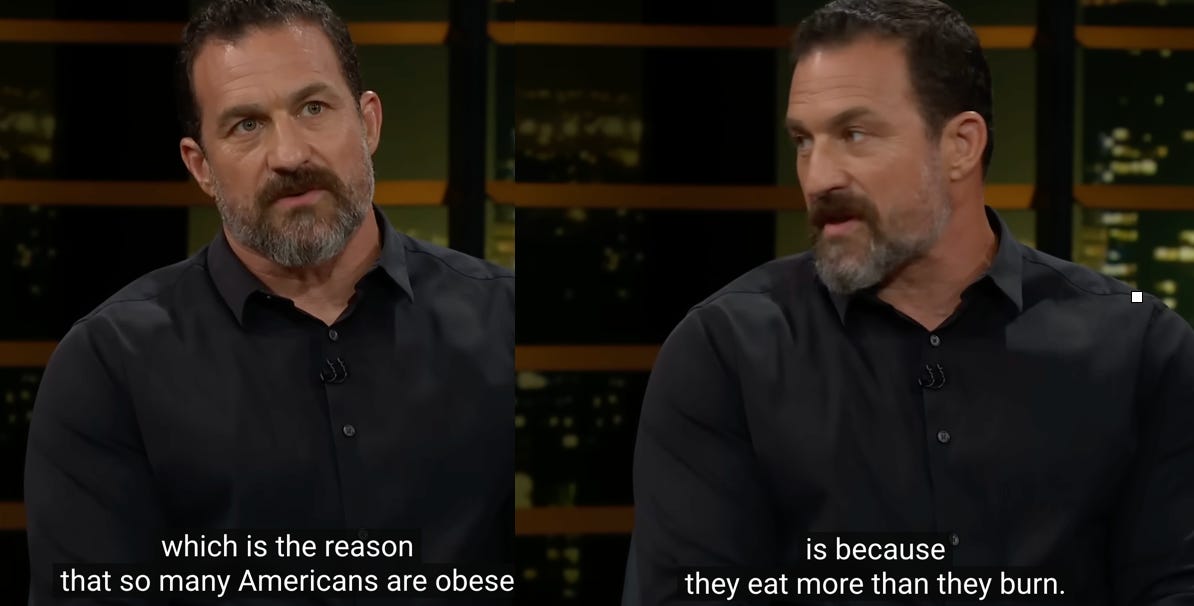
I would typically trust that assumption, but in this case Huberman and Thompson have strayed into my area of expertise. As such, the question “how do they know?” can be answered.
Keep reading with a 7-day free trial
Subscribe to Uncertainty Principles to keep reading this post and get 7 days of free access to the full post archives.