
Shouldn’t Giving Birth Be (Reasonably) Easy?
The Obstetrical Dilemma. What really makes human childbirth so hard?

The problem did not lie in any lack of clues. The problem lay in distinguishing the few clues that led in the right direction from all those that led in the wrong direction.
John Barry, The Great Influenza, 2004
Does this make any sense to you? Evolution (or your deity of choice) goes through all that trouble to induce us to procreate and assure the survival of our genes and our species, and then it makes the actual act of giving birth so painful, prolonged, and dangerous that it can kill or disable both mother and child just for going through with it. Any woman would have to be crazy, you’d think, to do it twice—and yet the more times she’s willing to do it, the more likely her lineage (and so her genes) will carry on.
It’s because of the pain and the complications of childbirth that a third of all births in the U.S. are now cesarean deliveries (according to the March of Dimes) and maybe one in five worldwide. Roughly 7 in every ten women in the U.S. will get an epidural to manage the pain, which certainly appears to be excruciating.1 Meanwhile, labor itself takes an average of 6 to 12 hours before the pushing begins, and another 1 to 3 hours for the actual delivery.
The issue I’m raising is known in the anthropology literature as the Obstetrical Dilemma. The dilemma is resolved—i.e., the conventional wisdom on this paradox— is that the pain and complications of childbirth are the result of an evolutionary compromise between the upright pelvis needed to walk on two legs (freeing up the hands for tool use, among other advantages) and the large heads and supposedly large brains required for the intelligence to use the tools, and the social interactions of tribal life.
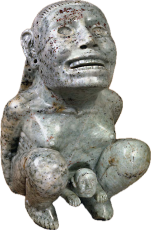
So we get our big heads, our two-legged gaits, and our hands free to do with them what we wish, but at a cost: the fit between the fetal head and the birth canal becomes so tight that the baby must actually rotate its head and shoulders mid-birth to navigate the changing shape of the pelvic opening. That’s where the pain and suffering come in.
The idea came together in a Scientific American article back in 1960, and as these evolutionary hypotheses often do, it evolved into a kind of consensus of expert opinion, a conventional wisdom on the subject, despite considerable evidence to the contrary and the occasional offering of an alternative hypothesis.2
In 2017, an article in Undark described an experience common in medicine—the reason the field of evidence-based medicine was invented—in which researchers went looking for the evidence to support conventional thinking and came up empty:
The assumption that “women are compromised bipedally in order to give birth” is widely accepted, says anthropologist Holly Dunsworth of the University of Rhode Island. But Dunsworth sees flaws in this premise. Women already have a range of dimensions in their birth canal, she thought, and they are all walking just fine. Indeed, research on human skeletons by anthropologist Helen Kurki of the University of Victoria in Canada has shown that the size and shape of the human birth canal varies very widely, even more so than the size and shape of their arms.
So in 2007, Dunsworth went looking for evidence to support the obstetrical dilemma as it has traditionally been understood.
“When I couldn’t, I thought I was crazy,” she says.
The denouement of that 2017 article was still the acknowledgment that “the process of birth is surprisingly complex in humans, compared to other apes.” But research published just this month, though, suggests this may not be true either.
